


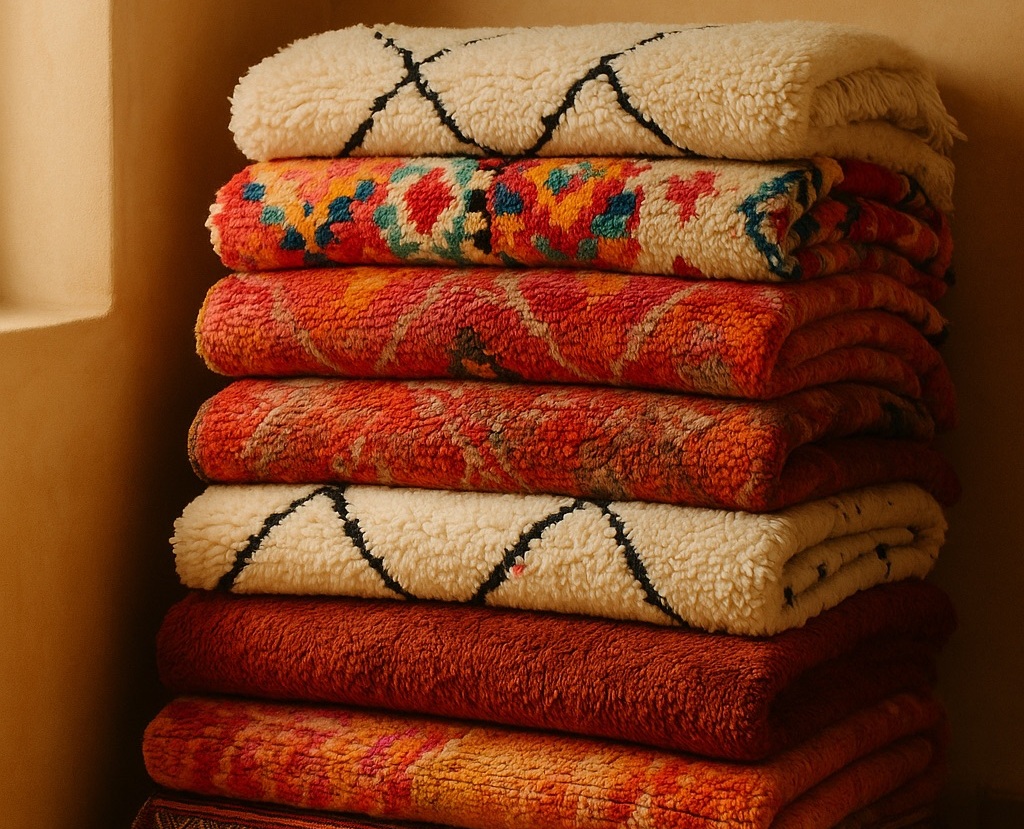
20 Jun MOROCCAN RUGS: A TRIBAL ART, A WOVEN MEMORY
In Morocco, the rug is much more than a simple decorative object: it’s an ancestral language, passed down from mother to daughter, where each knot is a fragment of history. Across the country, from the Atlas Mountains to the far reaches of the desert, each tribe perpetuates a unique, coded, vibrant weaving art deeply rooted in its territory. Here’s a journey to the heart of artisanal Moroccan rugs and the tribes that weave them.
1. ATLAS RUGS: THE MOUNTAINS AS A CRADLE OF EXPRESSION
🟣 BENI OUARAIN RUGS – WHITE, GEOMETRIC, TIMELESS
Tribe: Beni Ouarain (Middle Atlas)
Style: Cream or white background, black or brown geometric patterns
Wool: Very thick, virgin sheep’s wool
Meaning: Symbolic patterns (diamonds, crosses) representing protection, fertility, or life
Use: Originally used as blankets or thermal insulation
The Beni Ouarain rug, now a star of contemporary interiors, was designed to withstand the cold of the Atlas Mountains. It expresses great sobriety and a refined aesthetic that is popular worldwide. 🔴 Azilal Rugs – The Creative Explosion of the High Atlas
Tribe: Azilal (central High Atlas region)
Style: Light background, colorful and asymmetrical patterns
Symbols: Free forms inspired by everyday life, sometimes very modern
Special Feature: Blend of wool and cotton
These rugs boldly tell intimate or collective stories. They allow great freedom of interpretation to the weaver, often inspired by her environment or emotional state.
🔵 Boujaad Rugs – Warm and Feminine Colors
Tribe: Boujaad (Hauz plains, between the Middle and High Atlas)
Style: Red, pink, and orange hues; abstract, sometimes floral or spiritual motifs
Technique: Finer, more compact knots
Atmosphere: Romantic, expressive, sensual
These are rugs made of contrasts and poetry, where the hues evoke ochre earth and fire. Each piece is unique, a patchwork of memory and free inspiration.
2. SOUTHERN MOROCCO: BETWEEN DESERT, HEAT, AND SPIRITUALITY
🟠 Taznakht Rug – Berber Elegance from the Deep South
Tribe: Aït Ouaouzguite (Taznakht region)
Style: Complex, symmetrical patterns, rich in symbolism
Colors: Saffron yellow, madder red, green, and black
Technique: Knotted or flat-woven rug (hanbel)
Natural dyeing is one of the prides of these rugs. They combine artisanal finesse and tribal strength. The order, geometry, and precision reflect a cosmic balance.
🟡 Mrirt Rugs – Luxury and Refinement
Tribe: Beni M’rirt (Khénifra region)
Style: Very dense, often long-pile, in muted or pastel colors
Texture: Extremely soft and plush
Current Use: High-end rugs for modern interiors
Mrirt rugs are like foot cushions. They bring refinement while retaining Berber authenticity. They often feature patterns inspired by the Beni Ouarain, but reworked with denser wool.
3. THE NORTH AND EAST: LESSER-KNOWN BUT RICH TRADITIONS
🟤 Zemmour Rugs – Discreet charm of the central plateau
Tribe: Zemmour (near Rabat)
Style: Diamond patterns, often red, sometimes black background
Inspiration: Marriage, protection, fertility
Use: Very common in rural homes
These rugs illustrate the traditions of rural women who weave them by drawing on symbols inherited from their lineage.
⚫ Boucherouite Rugs – The Art of Recycling
Tribes: Various (created throughout Morocco)
Materials: Fabric scraps, wool, cotton, plastic
Style: Explosion of color, without fixed rules
Origin: Born from economic necessity
Each boucherouite rug is a free work, often very modern. These rugs reveal the adaptability of Berber women, who transform everyday life into art.
4. THE MEANINGS OF SYMBOLS: AN ANCIENT LANGUAGE
Moroccan rugs are not only beautiful. They are imbued with symbols, such as:
The diamond: fertility, feminine protection
The Hand of Fatima: protection against evil
The snake or zigzag: movement of water, life, rebirth
The broken lines: the paths of life
The cross: balance between the elements
These symbols are repeated from generation to generation, sometimes without the weavers being able to explain them—they are “known” rather than taught.
Conclusion: A treasure to be preserved
The Moroccan rug is a mirror of a changing world. At the crossroads of the useful, the spiritual, and the aesthetic, it tells of mountains, weddings, seasons, fears, and hopes. Each tribe weaves its own legends, and each rug is a mark, a signature, a secret shared in whispers.
Acquiring a Moroccan rug means entering a story. That of a woman, a people, a land. It also means participating in the preservation of a centuries-old expertise, now threatened by standardization.
No Comments