


24 Jun Peru in Our Hands
A journey into sacred, colorful, and living craftsmanship
It takes just one piece of fabric to understand that Peru is unlike any other country.
Here, colors shout without harshness. Patterns dance. Materials vibrate.
Peruvian craftsmanship does not seek neutrality—it boldly affirms an identity rooted in the mountains, the sacred, and the earth.
At Casbalova, we cherish these objects that speak entire worlds without a word.
Peru is one of them. Here’s a sensory and human journey through its ancestral know-how
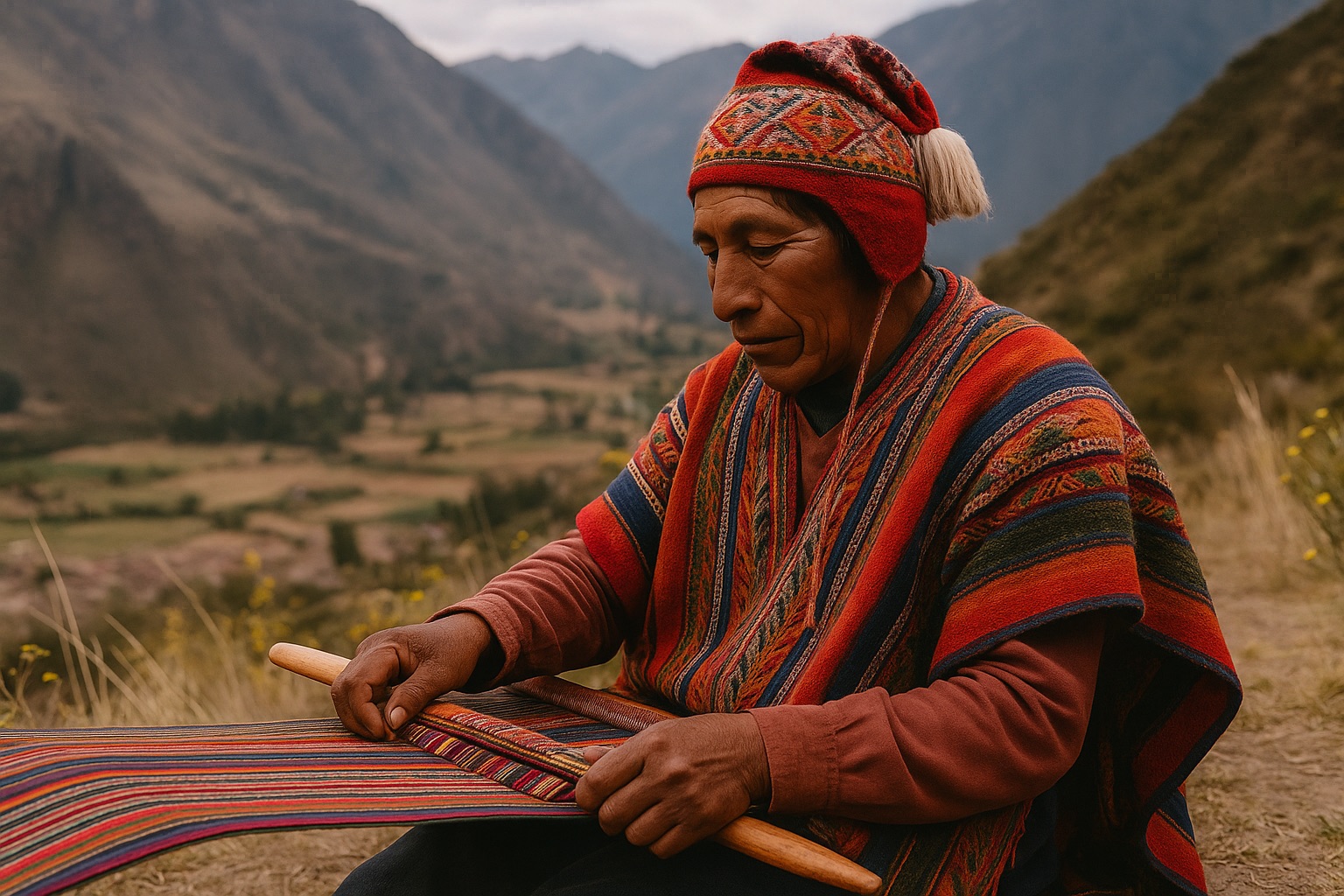
🧶 Weaving: The Language of the Andes
In Peru, textiles are living memory.
In regions like Cusco, Puno, or Ayacucho, women still weave by hand, just as their Quechua or Aymara ancestors once did.
Each thread is dyed with plants—cochineal, roots, flowers—and every pattern carries meaning: a protective animal, a sacred mountain, a nourishing river.
Chumpis (belts), mantas (large squares worn on the back), and tapices (wall tapestries) are not just “decorative” objects.
They are visual narratives, markers of identity, often woven four-handed—by mother and daughter.
✨ To weave in the Andes is to converse with nature. Every line tells a cosmogony.
🪶 Alpaca Wool: Warmth from the Heights
The alpaca, cousin of the llama, provides a fine, warm, soft—and sometimes temperamental—wool.
When carefully worked, it becomes a noble, breathable, and lightweight fabric.
It appears in ponchos, scarves, throws, and even in modern reinterpretations of traditional rugs.
But beyond the fiber itself, it is the community economy that stands out:
In Andean villages, shearing, spinning, dyeing, and weaving are shared between families.
Buying a handmade alpaca wool piece means supporting an entire village.
✨ A simple poncho thus becomes the fruit of an invisible circle of solidarity.
🌿 Ceramics, Wood, Gourd: The Everyday Elevated
In the lower valleys, earth becomes bowl, plate, or figurine.
In Chulucanas or the Amazon, potters often work with bare hands, without a wheel.
The black pottery of Chulucanas is fired in rudimentary kilns, polished with stones, and engraved by hand using simple tools.
Engraved gourds, typical of the Huancayo region, are carved with knives and partially burned to highlight the designs.
They depict rural life—markets, festivals, harvests.
A useful object… transformed into a miniature work of art.
✨ In Peru, nothing is purely functional. Everything holds a story.
🧭 What Peruvian Craft Teaches Us
It teaches us not to separate beauty from necessity.
To weave, sculpt, and shape in connection with the earth—and with one another.
To turn the everyday into a ritual, and every gesture into a tribute.
It reminds us that color is a language.
That slowness is a form of wealth.
That each object can carry a mountain, a song, a belief.
No Comments